缝纫机乐队
When a Chinese mythic world travels without translation_我的网站

A |

Chen Aijun works in an optical shop in Chengdu, southwest China's Sichuan Province, Aug. 14, 2026. (Xinhua/Lu Youyi)The video came with almost no instructions.
There was no narration explaining the mythology behind palaces rising above an ocean of clouds in the video, nor subtitles identifying the heavenly gates, cranes or tiny figures moving beneath them.
Yet viewers outside China quickly began naming the world for themselves.
Some called it "paradise." Others saw a "Celestial Palace" or an "Immortal Realm" familiar from Chinese fantasy games and television dramas. One user wrote, "Waiting on Wukong to show up," invoking the Monkey King from the Chinese literary classic "Journey to the West," or the hit game "Black Myth: Wukong."
The interpretations differed, but viewers did not seem to need the same cultural knowledge to enter the conversation.
Earlier this month, Chinese foreign ministry spokesperson Mao Ning shared the 33-second AI-generated video on social media with a question: "What does the Chinese heaven look like?"
It opened up a hermeneutic discussion, with responses overseas suggesting a cultural image does not necessarily need to elicit exactly the same interpretation for everyone in order for it to be viewed meaningfully.
"The right to interpret ultimately lies with the audience," said Zhang Zheng, deputy dean of Tsinghua University's School of Journalism and Communication.
People encountering unfamiliar cultures inevitably draw on what they already know, Zhang said. Rather than fully grasping every cultural reference, what matters is whether audiences can encounter the work, understand it and respond to it emotionally.
Before strangers abroad could interpret this particular world, however, it first had to get out of one man's head.
Chen Aijun, 34, is an optometrist in Chengdu, capital of southwest China's Sichuan Province.
By day, Chen leads a quiet, down-to-earth life in a neighborhood optical shop. Inside, he worked among eyeglass frames and optometry equipment. On his computer was another landscape entirely: cloud seas, immense palaces, flying cranes and figures in ancient robes.
Chen's heaven did not come from any single ancient text.
Growing up in the 1990s, he watched "Journey to the West" and later encountered "The Investiture of the Gods," xianxia (immortal heroes) novels and fantasy games. Those stories mixed over time with images of Chinese architecture and landscapes he saw online.
He has never visited nearby Mount Emei, and most of what he knows of Mount Huangshan's famous sea of clouds comes from videos.
What appeared on his screen was therefore not a reconstruction of one fixed mythological scene, but a world shaped by traditional stories already filtered through television, novels, games, the internet and his own memory.
For years, Chen had no way to make that world visible.
He never studied painting, design, photography or 3D modeling. After high school, he joined his parents' optical business and eventually took over the shop.
Generative AI changed the gap between imagining an image and possessing the technical skills to show it to someone else.
More than a year ago, Chen began teaching himself through free online tutorials. In September 2025, he started regularly posting AI videos, and a month later began experimenting with palaces floating above clouds. He has since published more than 200 videos.
The process, however, involves far more than entering a few prompts. The technology lowered the technical threshold, but it did not make the choices for him.
When creating Nantianmen, the mythical heavenly gate, Chen first defines the spatial rhythm and tonal hierarchy, pairing towering architecture and cloud seas with deliberately miniature figures to amplify the celestial realm's grand scale.
If the result does not match the picture in his mind, he tries again. He often generates over 1,000 images a day, revising a single scene repeatedly before moving on to animation, editing, color grading and music.
The machine can generate a thousand possible heavens. Chen still has to decide which one is his.
"AI-produced images can be soulless, and it takes human inspiration and aesthetic sensibility to endow works with warmth and vitality," he said.
Zhang believes Chen's experience reflects a broader shift brought about by generative AI. He said AI is giving people without conventional artistic training access to forms of expression that once required specialized skills. But what they create still depends on what they bring to the tool.
"A person's existing knowledge inevitably shapes how they use AI," Zhang said.
Chen brought his memories to the machine. Viewers abroad, in turn, brought theirs to the image.
"Everyone brings their own associations to these scenes," he said.
If his imagined world had to be reduced to three elements, he would keep clouds, architecture and people. The first two should feel immense, he said, while the last should remain small.
The details are culturally specific, but the visual effect is more immediate: tiny human figures dwarfed by vast clouds and monumental architecture. The responses suggest that viewers did not need to understand every cultural reference to find a way into the image.
Chen has no overseas social media accounts and learned that the video was attracting attention abroad only when friends sent him screenshots.
His life at the optical shop has changed little. He still checks eyesight and fits glasses when customers come in, then returns to his computer when the shop grows quiet.
He now hopes to make longer AI videos with fuller stories. He also wants to visit Mount Emei and, one day, Mount Huangshan.
For years, images of distant mountains and clouds reached Chen through screens. His imagined landscapes later traveled through screens to people he had never met.
Now he wants to see the real mountains and clouds for himself.
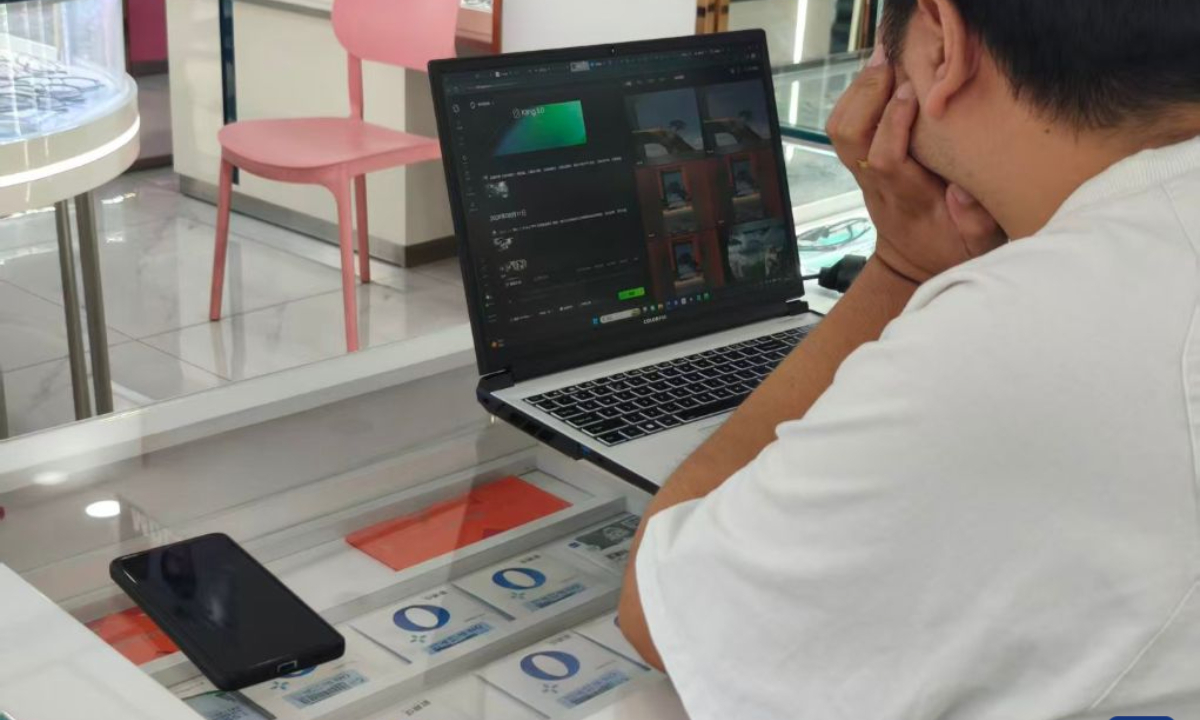
Chen Aijun makes AI videos in an optical shop in Chengdu, southwest China's Sichuan Province, Aug. 14, 2026. (Xinhua/Lu Youyi)
。 一名39岁的男司机因为在没有警员护送下,驾驶一辆超过4.5米标准高度的重型车辆进入隧道而被逮捕。(视频截图:Facebook/Singapore roads accident.com新加坡公路意外网页)一名39岁男司机因驾驶一辆超过4.5米标准高度的重型车辆进入隧道而被警方逮捕。

B | 《8视界新闻网》 早前报道,中央快速公路(CTE)昨天凌晨发生隧道天花板掉落事件,导致部分路段一度无法通车。警方回复《8视界新闻网》 询问时证实,昨早凌晨1点接获通报,指中央快速公路(CTE)往实里达快速公路(SLE)方向发生一起交通事故,涉及一辆自卸卡车。

C | 一名39岁男司机因在没有警察或辅警护送下,驾驶一辆超过4.5米标准高度的重型车辆进入隧道而被逮捕。警方表示,事故中没有人员伤亡,案件仍在调查中。
Current article:http://cq29.cuozubeishenjingli.cfd/wct/20260826/4041.html
Published on:19:38:10


